
Making Illegal States Impossible: In-Place Typestates in Pure PHP
Every developer has written some version of this nightmare:
$db->table('users')->delete();
// Congratulations, you just wiped production on a Friday afternoon because you forgot where()
Or this classic:
$tx->commit();
$tx->commit();
 // Fatal Error: No active transaction (and also no remaining dignity)
Or how about this universal gem?
$user = $session->getUser(); // Might be a User object, or might be null. Who knows? Spin the wheel!
if (!$user) {
    // We defensively copy-paste this check into 40 different controllers just to sleep at night...
}
These bugs exist because of a fundamental architectural blind spot we have politely ignored for decades: an object's type has zero idea what state it is actually in.
A closed File object will still cheerfully offer you a read() method. A QueryBuilder with zero fitlers will happily execute delete(). An idle database conection will smile and pretend it can commit(). The type system just sits there, sips its coffee, shrugs, and says: "Sure, looks valid to me!"
For nearly forty years, computer scientists have pursued a holy grail designed to end this madness: Typestate-Oriented Programming, the radical, mind-bending proposition that an object's type should actually reflect its current state.
Mainstream languages looked at this idea, nodded thoughtfully in academic conferences, and then did everything in their power to avoid implementing it properly. C# freezes the type in carbonite. Rust destroys the value and runs away with it. Static analyzers wave their hands and pray CI catches it.
And then there is TypePHP, which looked at the problem and asked: "What if we just mutated the generic type in place at runtime? In pure, unadulterated PHP?"
1. The Typestate Dream and the Language Compromises
In 1986, Robert Strom and Shaula Yemini published "Typestate: A programming language concept for enhancing software reliability" [1]. In 2009, Jonathan Aldrich’s research team at Carnegie Mellon took the concept and gave it a formal name: Typestate-Oriented Programming (TSOP) with the experimental language Plaid.
The premise is almost insultingly simple:
ClosedFile ──( open() )──► OpenFile ──( close() )──► ClosedFileWhen a file is closed, the read() method simply does not exist on the type. Calling it is a loud, impossible type error, not an embarrassing surprise at 3:00 AM in production.
Mainstream languages, however, treated this like a polite suggestion they had no intention of following.
A. C#: "We Can Emulate It" (By Committing Identity Theft)
A seasoned C# or Java developer will immediately interject: “Excuse me, you can totally do typestates in C#!”
Yes, technically. By throwing your original object directly into the incinerator and spawning a brand-new twin:
public class UnauthenticatedSession
{
    public AuthenticatedSession Login(string user, string pass)
    {
        return new AuthenticatedSession(user); // Out with the old, in with the new, object identity be damned!
    }
}
This is not in-place typestate mutation. This is identity theft with extra steps.
Three stubborn problems remain:
- Object identity is destroyed. You allocate a completely new heap object. The original never changed its type; it just became expensive garbage.
- The shared-reference model is broken. In everyday software, we assume that when the state of an object changes, every other variable pointing at that object will observe the new behavior. Replacement-object patterns quietly violate that trust. One variable gets the shiny new authenticated session, while every other service holding the old reference is left holding a stale, unauthenticated ghost.
- The CLR simply will not allow true in-place change. Generics are riefied. The method table pointer lives directly in the object header. Field offsets like
[RCX + 16]are baked into the compiled machine code. Mutating the generic parameters of a live object in place would scramble memory offsets and crash the virtual machine. The runtime would rather die than let you do this.
C# can simulate state transitions by playing musical chairs with replacement objects. It cannot evolve the type of a single shared reference while preserving the natural expectation that all aliases see the new state.
B. Rust: "Just Destroy the Old Value and Move On"
Rust implements typestates with zero-sized marker types, which is deeply elegant until you realize how it actually treats your data: like an angry toddler with trust issues.
impl File<ClosedState> {
    pub fn open(self) -> File<OpenState> { ... } // Consumes `self`. Permanently.
}
Look at that signature. Calling file.open() does not mutate the file. It eats the file, deletes the evidence, and hands you an entirely new object. The original variable is dead. If you dare try to use it again, rustc screams at you:
error[E0382]: use of moved value: `file`This is brilliant for writing operating systems, but it is hostile to normal object-oriented life.
If PHP adopted Rust's model, every state transition would force an awkward reassignment dance: $tx = $tx->begin(). Idiomatic reference pasing and dependency injection would be dead on arrival. Rust solved the problem by fundamentally refusing to share toys with anyone.
C. The Limits of Static Analysis (Psalm & PHPStan)
Psalm originally pioneered this space with @psalm-this-out, which was later introduced to PHPStan 1.9 by Richard van Velzen under the @phpstan-self-out banner. Both let a method declare that it changes $this’s generic type:
/** @self-out self<Authenticated> */
public function login(): void { ... }
This was a genuine triumph for static analysis. But the limitation is structural: static analyzers never actually run your code.
They reason about source text, abstract syntax trees, and control-flow graphs. At runtime, DocBlocks are just nostalgic text comments. When un-sanitized HTTP payloads, dynamic DI containers, or shared references hit your application, static analyzers are sitting on the sidelines while your production server burns.
2. The TypePHP Breakthrough: Decoupled Reification via \WeakMap
TypePHP took those exact same static annotations, looked at PHP's dynamic object model, and said: "What if we stop pretending and actually enforce this in RAM?"
- Decoupled Identity: The native PHP
zend_objectstays untouched. TypePHP stores generic type arguments in an external\WeakMapkeyed by the instance. - In-Place Mutation: When a method annotated with
@self-out self<Authenticated>finishes, TypePHP overwrites the type tag for that exact object in\WeakMapmemory. - Every Alias Sees the New State: Because the object identity (
spl_object_id) never changes, every variable that points at the instance immediately observes the updated typestate.
No shiny new replacement objects. No destructive moves. No orphaned variables left stranded in outer scopes. Just the exact same object in heap memory, smoothly evolving into a new type, enforced everywhere it travels.
3. Static Analysis Meets Runtime Reality
Static analysis is great at catching typos before you commit. It is, by design, powerless to observe what actually happens to an object once the program is running.
We built a small typeatate machine that exercises three patterns that appear constantly in real production code:
- Using generic defaults (
@template TState of State = Unauthenticated) so we never even have to write@varcomments on instantiation! - Passing the object through an alias (
$shared = $alice), the classic shared-reference case that most PHP code relies on. - Sending it through an untyped framework boundary (
untypedLayer(object $s)).
The same code was analyzed by PHPStan at Level MAX and then executed under TypePHP's live runtime engine.
What PHPStan Reports: 3 Errors (2 False Positives)
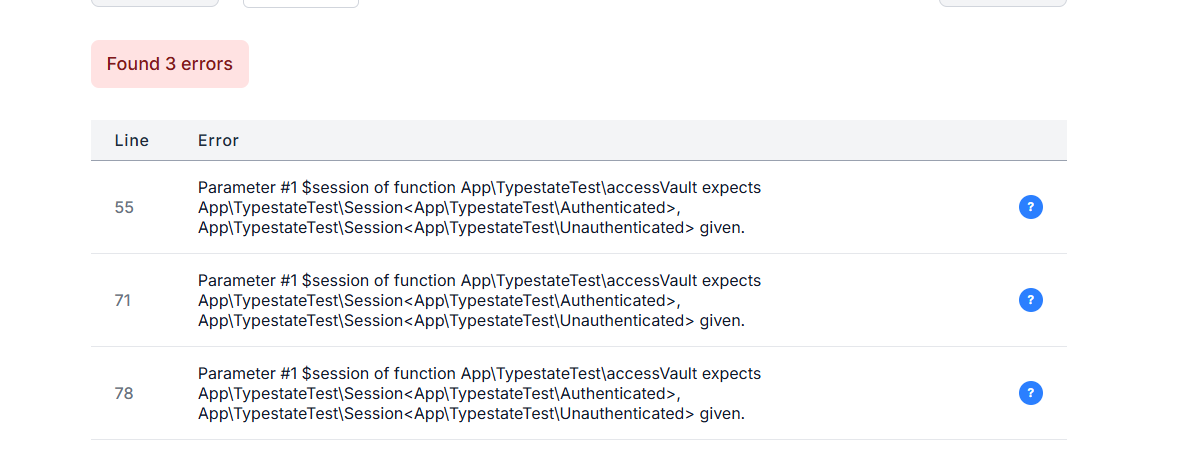
PHPStan halted with 3 errors:
- Line 55 (The Aliasing Blindspot): PHPStan reported that
$sharedwas unauthenticated, because static flow analysis tracks variable names, not physical heap pointers. It had no idea$alice->login()updated the shared instance in RAM. - Line 71 (The Opaque Boundary): Because
$bobpassed throughuntypedLayer(object $s), PHPStan lost track of the transition and falsely claimed$bobcould not access the vault. - Line 78 (The Legitimate Catch): PHPStan correctly caught
$s1after it logged out.
Notice that out of 3 errors reported by PHPStan, two were false positives on safe, legitimate code, purely because static analysis cannot follow heap pointers.
What Happens When the Code Actually Runs
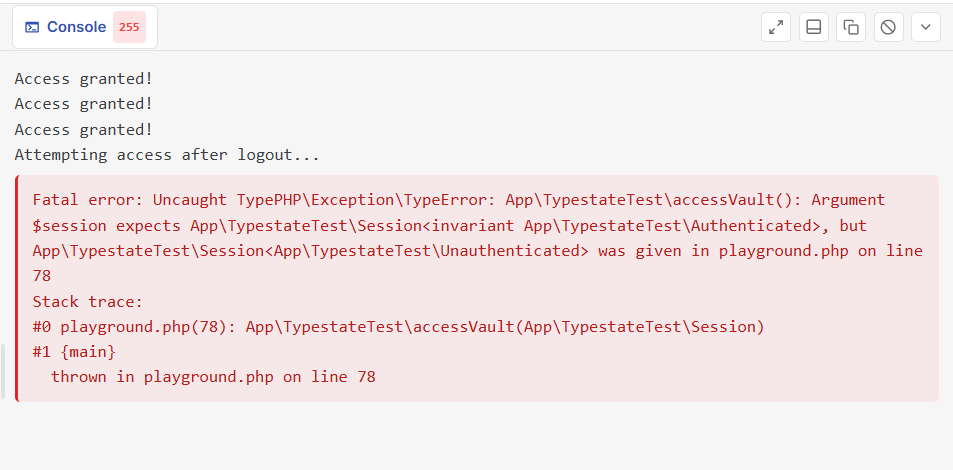
Now run the exact same code below inside TypePHP's live WebAssembly engine:
Try it yourself
- Click Run below. All three accesses succeed cleanly with
Access granted!, followed by line 78 halting with an uncaughtTypeErrorbecause$s1logged out! - Click Edit, comment out line 76 (
$s1->logout();), and run again. All four accesses now succeed with Exit 0! - Open the exact same code in the PHPStan Playground to see the 3 static errors side by side.
<?php

declare(strict_types=1);

namespace App\TypestateTest;

interface State {}
class Unauthenticated implements State {}
class Authenticated implements State {}

/**
 * @template TState of State = Unauthenticated
 */
class Session
{
    /**
     * @phpstan-self-out self<Authenticated>
     */
    public function login(): void {}

    /**
     * @phpstan-self-out self<Unauthenticated>
     */
    public function logout(): void {}
}

/**
 * Gatekeeper function: Strictly requires an Authenticated session!
 *
 * @param Session<Authenticated> $session
 */
function accessVault(Session $session): void
{
    echo "Access granted!\n";
}

// -------------------------------------------------------------
// 1. Direct Transition (Both PHPStan & TypePHP Pass)
// -------------------------------------------------------------

$s1 = new Session();
$s1->login();
accessVault($s1); // ✓ Succeeded in both!

// -------------------------------------------------------------
// 2. The Aliasing Test (PHPStan fails on line 55, TypePHP succeeds)
// -------------------------------------------------------------

$alice = new Session();
$shared = $alice; // Points to the EXACT same instance in RAM!

$alice->login();

// PHPStan throws a false positive here because it tracks variable names:
accessVault($shared); // ✓ TypePHP succeeds!

// -------------------------------------------------------------
// 3. Opaque Framework Boundary (PHPStan fails on line 71, TypePHP succeeds)
// -------------------------------------------------------------
function untypedLayer(object $s): void
{
    if ($s instanceof Session) {
        $s->login();
    }
}

$bob = new Session();
untypedLayer($bob);

// PHPStan throws a false positive here because $bob passed through `object`:
accessVault($bob); // ✓ TypePHP succeeds!

// -------------------------------------------------------------
// 4. Runtime Gatekeeping (Both PHPStan and TypePHP Catch This)
// -------------------------------------------------------------
$s1->logout();
echo "Attempting access after logout...\n";
accessVault($s1); // Both agree: Throws TypeError on line 78!TypePHP succeeds here for three concrete reasons:
- Zero Boilerplate: By declaring
@template TState of State = Unauthenticated,$s1 = new Session()defaults cleanly toUnauthenticatedwithout needing@varcomments. - Heap Pointer Aliasing: It keys state by
spl_object_id. When$alice->login()runs, the physical instance updates, so$sharedreflects the change immediately. - Observing the Actual Heap: It observes what physically happened in memory, not what a static symbol graph guessed. Both tools agree on line 78, but only TypePHP lets lines 55 and 71 run as intended.
4. Real-World Domain: Bulletproof Database Transactions
Database transactions are the gift that keeps on giving to incident reponse channels: call commit() twice or query an idle connection, and you get silent data corruption or loud exceptions.
Try it yourself
- Click Run to watch the uncaught
TypeErroron line 45 when atempting to transfer funds on a committed transaction. - Click Edit, comment out line 41 (
$db->commit();), and run again. The second transfer now succeeds with Exit 0!
<?php

declare(strict_types=1);

use TypePHP\TypePHP;

interface TransactionState {}
class IdleState implements TransactionState {}
class ActiveState implements TransactionState {}
class CommittedState implements TransactionState {}

/**
 * @template TState of TransactionState
 */
class TransactionalConnection
{
    /** @self-out self<ActiveState> */
    public function begin(): void { echo "✓ BEGIN\n"; }

    /** @self-out self<CommittedState> */
    public function commit(): void { echo "✓ COMMIT\n"; }
}

class BillingService
{
    /** @param TransactionalConnection<ActiveState> $db */
    public function transferFunds(TransactionalConnection $db, int $amount): void
    {
        echo "✓ Transferred \${$amount} safely inside active transaction!\n";
    }
}

/**
 * @var TransactionalConnection<IdleState>
 */
$db = new TransactionalConnection();
$billing = new BillingService();

$db->begin();
$billing->transferFunds($db, 500); // Permitted!
$db->commit();

// Attempting to transfer on a committed transaction halts with TypeError:
echo "Attempting transfer on committed transaction...\n";
$billing->transferFunds($db, 250);Notice what this eliminates:
- No defensive checks like
if (!$db->inTransaction())scattered through business logic. - No awkward
$db = $db->begin()reassignment gymnastics. - Passing an idle or already-committed connection into
transferFunds()is an immediate, unbreachableTypeError.
Conclusion: Different Languages, Different Trade-Offs
It is easy to look at PHP's lack of native C-level reified generics and assume the language is behind compiled peers like C# or Rust. But language design is always an exercise in choosing the right trade-offs for a specific domain:
- C# and Swift prioritized raw throughput and cache-friendly memory layouts by embedding generic metadata directly into physical object headers, making in-place type changes an intentional impossibility for safety and performance reasons.
- Rust chose affine ownership to guarantee thread safety and memory management without a garbage collector, which naturally models state machines by moving and consuming values rather than mutating shared references. It is a brilliant design for systems programming.
- TypePHP takes advantage of PHP's dynamic, garbage-collected object model to decouple generic metadata into an external
\WeakMap, evolving the type tag in place while keeping the shared-reference model that PHP developers rely on every day.
The result is practical in-place Typestate-Oriented Programming: state machines enforced by structural type contracts without breaking reference identity, all running in 100% pure PHP.
Different languages make different compromises for their runtimes. In PHP's case, its dynamic userland turned out to be the exact architectural ingredient needed to make in-place typestates feel right at home.
Have a state machine or workflow you would like to model? Check the dedicated Mutable Generics & Typestates Guide or try it live in the Interactive WebAssembly Playground.